



Step into any modern gym, and you're immediately faced with a choice: head to the gleaming rows of selectorized resistance machines, or walk over to the clanking plates and heavy rubber mats of the free weight section. It's a debate that's been raging in locker rooms for decades - are you better off pulling pins on a weight stack, or gripping a cold, iron barbell?
I used to think weight machines were just for older folks or tourists at hotel gyms, while "real" lifters only used barbells and dumbbells. The truth? Both tools have massive, unique benefits depending on your immediate goals, your experience level, and how much gas you have left in the tank at the end of a workout.
If you genuinely want to understand the pros and cons of free weights versus weight machines, let's break down where each piece of equipment shines so you can stop guessing and start growing.
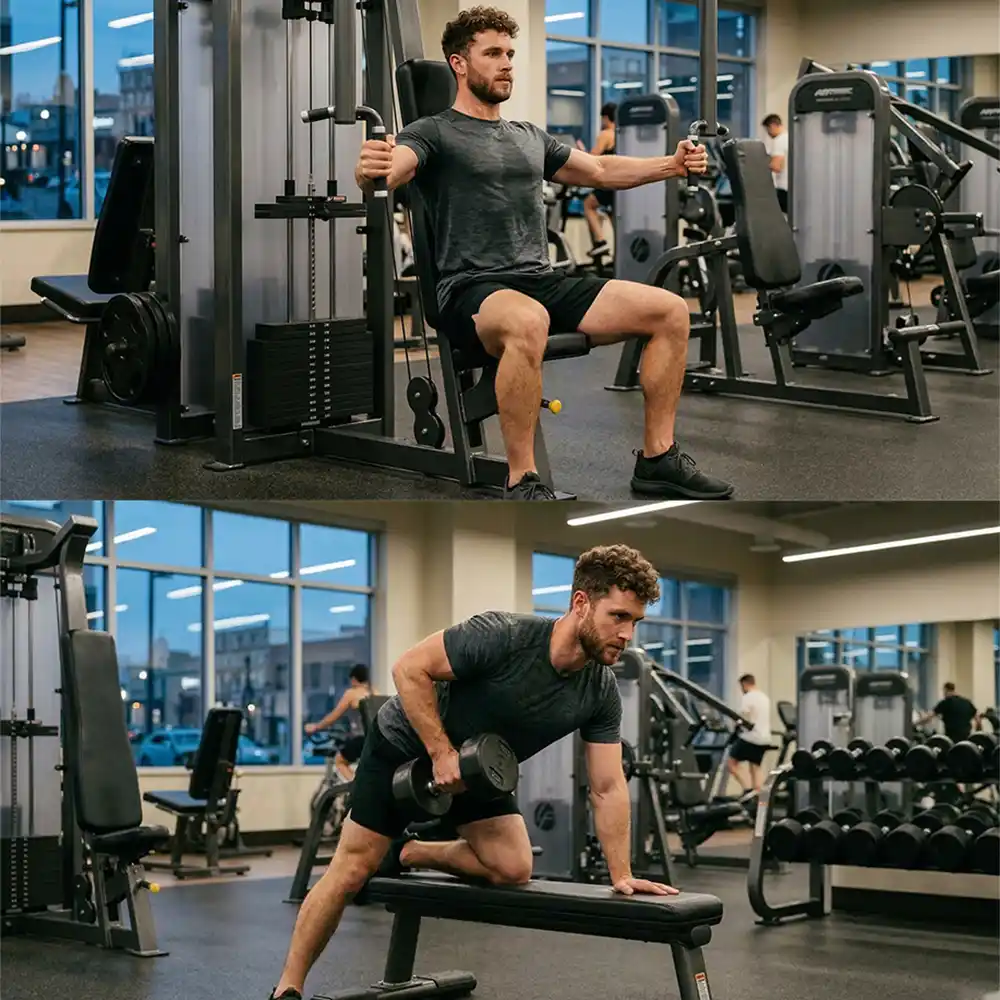
The Gym's Deck of Cards: Barbells, Dumbbells, and Machines
Before we start arguing over which piece of equipment is best, it helps to know exactly what we’re dealing with. If you look around the floor of any commercial gym, nearly everything you see falls into one of two camps: free weights or machines.
Free weights are exactly what they sound like - heavy objects you can pick up, hold, and move freely in any direction. There are no cables, no tracks, and no safety nets guiding your path. The heavy hitters here are:
- Barbells: The long, iron bars you slide heavy plates onto. They're the absolute standard for moving massive amounts of weight.
- Dumbbells: The shorter, hand-held weights that force each of your arms to work completely independently.
Machines take a totally different approach. They lock you into a specific, guided path of motion. You’ll usually see four main variations scattered around the gym:
- Pin-Loaded Machines: The most common ones you'll see. They feature a tall stack of rectangular plates - you just pull a pin and drop it into the weight you want.
- Plate-Loaded Machines: Think of a big leg press machine. They have a fixed track for the movement, but you still have to haul heavy barbell plates over to load up the pegs yourself.
- Cable Machines: These use adjustable pulleys and wire cables, giving you constant tension from pretty much any angle you can imagine.
- Smith Machines: The weird hybrid in the corner. It looks like a barbell, but the bar is permanently attached to vertical guide rails so it can only travel straight up and straight down.
If you were to look at all of this equipment like a deck of cards, the barbell is the King. It sits right at the top of the food chain, demanding total respect, focus, and raw power. If your goal is to push your body to its absolute limits and build maximum strength, the King is your go-to.
The dumbbell is the Queen. She might not be able to carry the sheer, overwhelming tonnage of the King, but she makes up for it by being incredibly versatile and agile. You can move dumbbells in any direction, use them to fix strength imbalances between your left and right arms, and hit weird angles that a stiff barbell just can't reach.
That brings us to the machines - the Jacks. They’re the reliable, hard-working foot soldiers of the gym. Sure, they might lack the royal prestige of the heavy free weights, but they execute their specific jobs with ruthless, mechanical efficiency. When your stabilizing muscles are completely burnt out and the Kingdom’s heavy lifting is done for the day, you call in the Jacks to finish the job safely.
Why the Leg Press is a Beginner’s Best Friend
Let's be honest - walking up to a squat rack for the first time is incredibly intimidating. Balancing a heavy barbell on your back while simultaneously trying to remember the cues for foot placement, depth, and breathing is a recipe for disaster if you've never moved against heavy resistance before.
This is precisely where machines save the day. Because the machine dictates the path of the movement, the learning curve is nearly nonexistent. Instead of worrying about stabilizing the weight, a new lifter can sit in a leg press or chest press machine and focus entirely on the sensation of their muscles contracting against resistance.
It’s a fantastic way to quickly and safely develop initial strength, condition the joints and tendons, and build confidence. You don't need a spotter, and if you fail a rep, the weight stack simply clanks safely back into place. For this reason, machines are often the perfect gateway drug into the wider world of strength training.
The Pec Deck Machine: Man's Best Friend in the Gym
If the leg press is a beginner's best friend, then the Pec Deck Fly Machine is undoubtedly man's best friend in the gym. Let's be real - you have probably spent countless hours at the gym pushing heavy barbells and dumbbells, desperately trying to get your chest muscles to pop and create that highly sought-after, deep "vertical line" of separation down the middle of your chest. We all secretly want to hit that iconic "most muscular" bodybuilding pose and look like Lou Ferrigno bursting out of his shirt as The Incredible Hulk.
The problem with standard free weight presses is that the tension drops off drastically at the top of the movement when your arms are straight. The pec deck machine solves this entirely. It mimics the exact mechanical motion of the most muscular pose, providing constant, agonizing tension on the pectoral fibers even when your hands meet in the middle. This allows you to force maximum blood flow and achieve that perfect inner-chest contraction that free weights simply cannot match.
Free Weights Build the Muscles You Didn't Know You Had
So, if machines are so easy and safe, why bother with free weights? Try doing a heavy standing overhead dumbbell press and you'll find out immediately.
When you use a barbell or dumbbell, you aren't just pushing weight in a straight, guided line. You have to stabilize the load in three dimensions. Every time you squat, deadlift, or press a free weight, dozens of smaller muscles - your core, your stabilizers, your grip - have to fire in unison just to keep you from falling over or dropping the weight.
Machines artificially remove this stabilization requirement. A machine chest press might hammer your pecs, but it leaves your stabilizing rotator cuff muscles largely out of the equation. Over time, relying exclusively on machines can lead to imbalances where the primary-mover muscles become incredibly strong, but the supporting structures lag behind. Free weights build a rugged, coordinated strength from head to toe.
This is especially obvious when analyzing the Smith machine versus free weights. On a standard barbell back squat, your body must balance the massive load front-to-back and side-to-side. In a Smith machine squat, because the bar is locked into a fixed vertical track, that massive stabilization demand is entirely removed. While the Smith machine can securely overload the quads, it simply cannot replicate the full-body strength built by an unrestrained free-weight barbell.
When to Use Machines (Hint: It’s Not Just for Beginners)
It would be a mistake to assume machines are just training wheels you leave behind once you get strong. In fact, professional bodybuilders rely heavily on machines, particularly for a concept called hypertrophy (muscle growth).
Because machines strip away the need for balance and stability, you can push a specific muscle to absolute, grueling failure safely. Think about trying to do a drop set with a barbell squat: you'd have to rack the bar, strip plates off both sides, get back under the bar, unrack it, and go again. By the time you're ready, you've already rested too long.
This is unfortunate because drop sets are one of the most effective muscle-building protocols in existence. A systematic meta-analysis published in Sports Medicine confirmed that drop sets yield identical muscle hypertrophy as traditional sets but in a fraction of the time. Similarly, clinical research demonstrates that the massive metabolic stress triggered by drop sets leads to superior muscle thickness gains compared to standard protocols. Furthermore, research published in the International University Strength and Conditioning Association (IUSCA) journal continues to highlight advanced training techniques - like drop sets - as optimal for maximizing muscle fiber recruitment.
With a leg extension machine, you can simply reach down, move the pin up a slot, and immediately continue the set while your quads are screaming. This ability to instantly adjust weight, maintain continuous tension, and safely train to muscular failure makes machines an invaluable tool for executing these scientifically backed, high-intensity techniques to blast a muscle at the end of a hard workout.
Tracking Hypertrophy with Gym Log Track
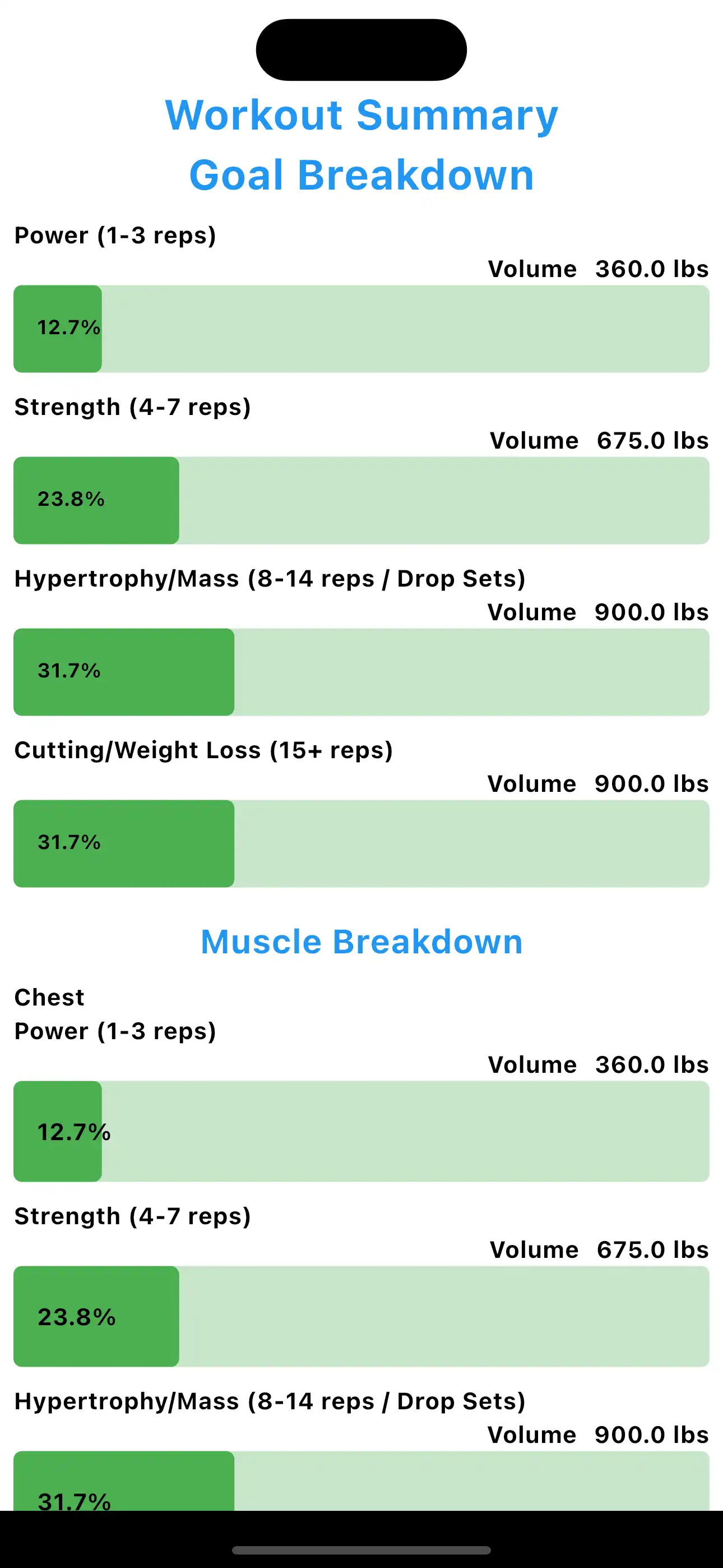
When you're pushing past your natural limits with high-intensity techniques like drop sets, relying on your memory just won't cut it. Gym Log Track's feature targeting Workout Goals is specifically designed to help you meticulously log your workout goals and monitor your total volume week over week.
If your goal is triggering serious muscle growth, the app allows you to instantly record multiple drop sets without interrupting your workout flow. You can visualize your progress over time, ensuring that the brutal sets you do on those weight machines are actually moving the needle toward your hypertrophy targets.
Lifting Heavy Things in the Real World Requires Free Weights
If your only goal is to look good at the beach, you could arguably get away with using machines alone. But if you want your gym strength to actually translate into real-world capability, you need free weights.
Life does not happen on a fixed axis. Whether you are hauling a heavy bag of mulch out of the trunk of your car, wrestling with your kids, or moving a couch up a flight of stairs, your body has to coordinate multiple joints, engage your core, and balance an awkward load against gravity.
Movements like deadlifts, lunges, and farmer’s carries perfectly mimic these real-world demands. They teach your central nervous system how to produce and control force naturally. Athletic programs heavily emphasize free weights for exactly this reason: it doesn't matter how much you can chest-press on a machine if you get shoved off balance the second you step onto a football field.
The Verdict: Stop Choosing Sides
The truth is, forcing yourself into completely abandoning one method for the other is a massive mistake. The best, most enduring training programs steal the best elements from both camps.
A smart workout structure typically starts with heavy, complex free-weight movements - like squats, barbell rows, or deadlifts - when your energy levels are highest and your central nervous system is fresh. These are the lifts that build your foundational, functional strength.
Then, as your stabilizers begin to fatigue later in the workout, you can safely transition to weight machines to isolate specific muscles and push them to failure without risking form breakdown or injury. By blending the rugged, real-world utility of free weights with the targeted, safe intensity of resistance machines, you're guaranteed to build a body that looks as capable as it actually is. Next time you step into the gym, use the whole floor.